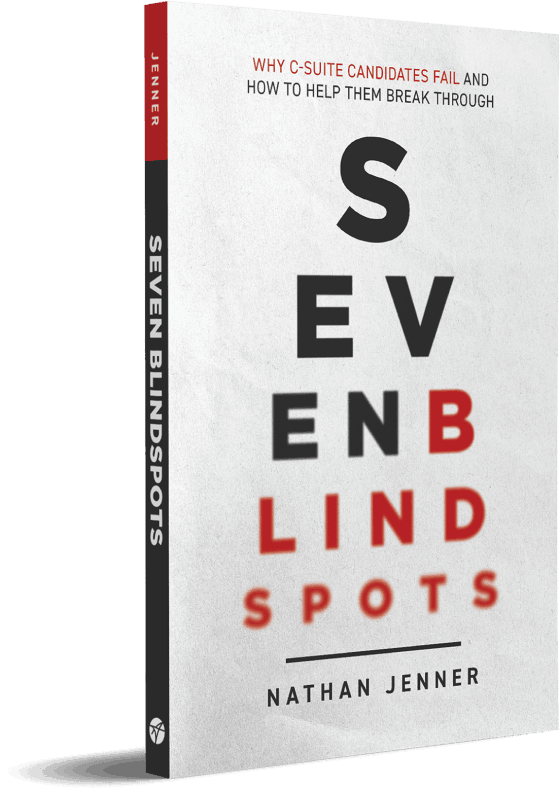
Book

ExecutiveCode

Shape Icon

Seven Blindspots

Why C-Suite Candidates Fail and How to Help Them Break Through

Why do some executives reach the top while others—with equal intelligence, experience, and ambition—stall just short of it?

Drawing on twenty-five years assessing and developing more than 3,000 senior leaders, Nathan Jenner reveals seven recurring blindspots that determine who thrives at the top and who, despite visible strengths, stalls. These gaps are rarely detected in traditional interviews or performance reviews, yet they surface with force once a leader steps into the role.

Publishing January 2027

Purchase Your Copy Below

New book up image

Praise for Seven Blindspots

“Leadership is a journey of continuous learning, and the willingness to see ourselves clearly is one of its greatest strengths. Seven Blindspots challenges leaders to grow beyond what made them successful and offers practical insights for becoming even more effective. It's an important read for CEOs, boards, and everyone committed to developing exceptional leaders.”

Gail Boudreaux

President and CEO, Elevance Health

“Standard succession planning rotates executives through functions and assignments. That's valuable. Seven Blindspots fills what's missing. It's the overlay that sits on top of it — systematically identifying and developing the blindspots often missed as leaders elevate to run the enterprise.”

Steve Hasker

President and CEO, Thomson Reuters

“One of the Board's critical responsibilities is to ensure successful CEO succession planning. Jenner's research has identified the critical factors that lead to success and details how blind spots can be identified and mistakes avoided before it's too late.”

David Benson

Former President and Interim CEO, Fannie Mae; Independent Board Director

“Seven Blindspots identifies patterns I sensed across my career but had never seen captured with such precision. It is clear-eyed about what truly separates leaders at the top and profoundly practical about how to close the gaps that too often remain invisible until the cost becomes unmistakable.”

Eric Veiel

President and Chief Investment Officer, T. Rowe Price

“After five decades in leadership positions, I came to believe nothing beats an engaged, energized and aligned organization, and that leaders who cannot build one eventually plateau no matter how strong their operating record. Seven Blindspots is a fresh and original perspective rather than a rehash of the leadership canon — it isolates the specific capabilities that separate executives who scale from those who stall, and importantly, treats those capabilities as developable. This is a must read for any board or CEO responsible for the next generation of leadership.”

Robert J. Maricich

Founder and Executive Chairman, ANDMORE

“The more senior the role, the harder it becomes to get honest feedback — to be challenged, to be told what you most need to hear. Seven Blindspots names the recurring themes that hold even the most senior leaders back. Refreshing and novel next to the usual articles and advice. Practical and real.”

Liz Cole

Former CHRO, Marsh; former CHRO, Cambia Health Solutions

“Nathan brings rigor and insight to evaluating candidates that few boards reach on their own, seeing what others miss and anticipating consequences. Seven Blindspots puts that same discipline on the page. This is essential guidance for boards, CEOs and CHROs making succession decisions.”

Michelle Bottomley

Board Director and CEO

“Even the most experienced executives have blind spots, and without rigorous assessment and candid feedback, those gaps can quietly erode value. Seven Blindspots helps boards and investors identify those risks early and, just as importantly, understand how to support a leader rather than simply place a bet on one.”

Monique Honaman

Managing Director, Private Equity Portfolio Talent

“Seven Blindspots closes the gap between research and practice. Jenner translates rigorous organizational psychology into a practical framework that helps boards and CEOs make better decisions about the executives they select and develop for high-stakes business transitions.”

Debra A. Noumair

Professor of Psychology and Education, Teachers College, Columbia University; Founder and Faculty Director, Executive Master's Program in Change Leadership

“I've watched talented executives rise on operational skill and then stall in their careers. Why? Because the job at the top is about strategy, politics, EQ, and leading people through change–not just managing operations. This book names that gap honestly, and it's built by someone who's been on the field, not just studied it.”

Bryan P. Powell

CEO, Westwood Professional Services

“Nathan sees what actually derails executives at the top — the patterns most miss. Seven Blindspots names them and, just as importantly, shows how to develop past them.”

Amy Mulderry

Former President, CarelonRx

The Seven Blindspots

Each chapter opens with a real executive whose blindspot surfaced under assessment—what their organization missed, what it cost, and the development work that closed the gap when it was closable.

Confusing Clarity with Persuasion

They fail to inspire stakeholders to action—even brilliant analysis gets brushed aside, and good ideas stay inert.

Getting Trapped in Execution

They struggle to release the behaviors that earned their advancement—their focus on executing and optimizing today's plan becomes insufficient. Without the ability to sense the future and position their organizations accordingly, even operationally brilliant leaders plateau and their enterprise stagnates.

Succeeding Through Heroics, Not High-Performing Teams

They cannot build high-performing teams and are forced to trade their role as strategic architect for that of referee. Their days are consumed by managing friction, confusion, and underperformance—while the enterprise bleeds talent and momentum.

Dismissing Organizational Power and Politics

They treat organizational power and politics as an alternative to merit, rather than an essential complement to it—and lose the ability to mobilize the organization.

Mistaking Debate for Sound Decision-Making

They cannot facilitate high-stakes group decisions—leaving collective intelligence on the table, allowing obvious options to crowd out creative alternatives, and mistaking polite silence for commitment.

Preaching Change, Not Rewiring Behavior

They approach change as a communication and project management challenge rather than a human and structural one—winning intellectual agreement while failing to rewire behavior, leaving the organization stalled as the market moves on.

Rubber-Stamping CEO Succession

The board and the CEO treat executive succession as a rubber-stamp exercise, rather than a rigorous alignment of mandate and capability. This leads to selecting the wrong leader entirely or suffocating a new CEO under hidden friction and misaligned expectations.

Mistaking Debate for Sound Decision-Making

They cannot facilitate high-stakes group decisions—leaving collective intelligence on the table, allowing obvious options to crowd out creative alternatives, and mistaking polite silence for commitment.

Preaching Change, Not Rewiring Behavior

They approach change as a communication and project management challenge rather than a human and structural one—winning intellectual agreement while failing to rewire behavior, leaving the organization stalled as the market moves on.

Rubber-Stamping CEO Succession

The board and the CEO treat executive succession as a rubber-stamp exercise, rather than a rigorous alignment of mandate and capability. This leads to selecting the wrong leader entirely or suffocating a new CEO under hidden friction and misaligned expectations.

From the Book To the Boardroom

The framework in these pages is the same one Nathan applies with boards, CEOs, and investors—in executive assessments, succession processes, and leadership diagnostics.

The book explains the framework. The advisory work applies it.

Nathan Jenner press

What Blindspots Are Limiting Your Organization?

The most costly leadership risks are the ones nobody sees coming.

Nathan Jenner advises boards, CEOs, and investors on CEO succession and executive assessment and development. He is the author of Seven Blindspots.

Read the first chapter.